
Read It & Reap Part 1
- Patrice Britto
- May 1
- 3 min read
Updated: May 1

The Involvement of Low Literate Parents in Supporting the Academic Development of their School Aged Children in Trinidad and Tobago
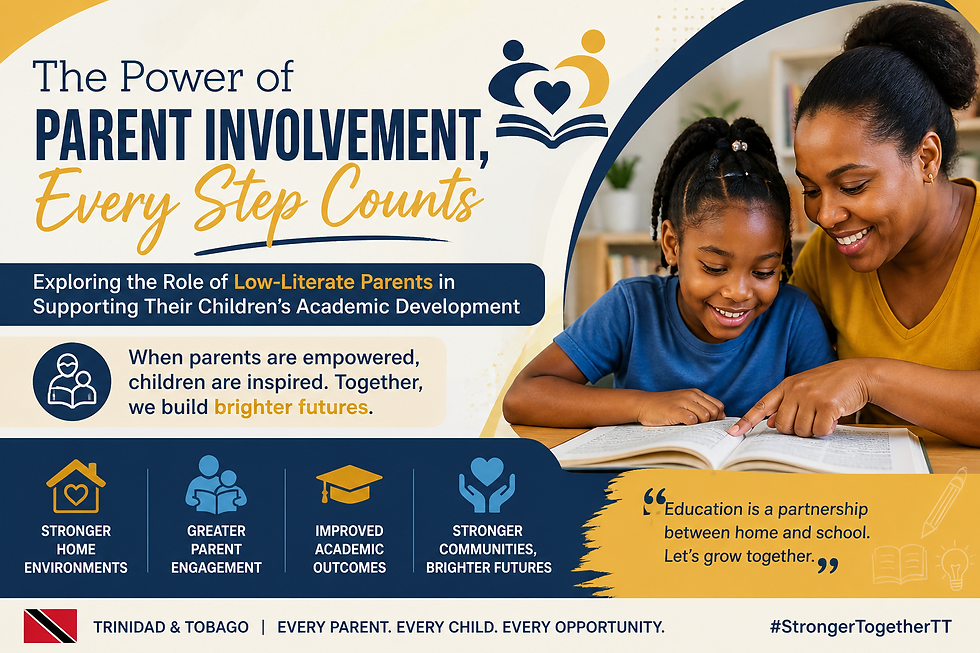
Literacy in any context forms the foundation of all learning and socio-economic participation, and because of this, research in this area is of utmost importance (UNESCO, 2023; World Bank, 2022). There has been an alarming rate of concern about reading proficiency at the primary school level in Trinidad and Tobago, and as such there is a need for a deeper investigation into the factors that may contribute to this beyond the walls of the classroom (Ministry of Education Trinidad and Tobago, 2023; ALTA, 2022). One major factor that should be highlighted is the involvement of parents at the home level, especially among those who may be functioning at low literacy levels (Epstein, 2018; Hoover-Dempsey & Sandler, 2005). By placing a focus on these two simultaneously, this research can unearth how home environments either make or break a child’s literacy development (Bronfenbrenner, 1979; Sénéchal & LeFevre, 2002).
The findings of this study can be the catalyst for the creation of targeted intervention strategies, adjustments to policies at a national level, and literacy programmes at a community level (UNESCO, 2023; OECD, 2021). These can be aimed at breaking intergenerational cycles of low literacy that continue to affect our nation’s classrooms (World Bank, 2022; UNESCO Institute for Statistics, 2021). This would also play a significant role in improving national assessments such as the Secondary Entrance Assessment (SEA) and in fostering lifelong learning (Ministry of Education Trinidad and Tobago, 2023).

Literacy has always held a very special place in my heart especially as I saw my own father struggle throughout my childhood. It is only now that I am an adult I can see him showing considerable signs of growth in this area. Despite this, one of the most exhilarating things for me as I approach my research has been the exploration of the relationship between the literacy practices at home and student achievement. It has been eye-opening to see factors such as parents’ reading habits, their attitude towards education in general and their level of confidence in working directly with their children’s literacy development. One thing I have always emphasised throughout my career as a primary school teacher is the fact that education is a triangular partnership. A partnership that involves the teacher, the student and the parent. Once all three persons work hand in hand then it lightens the load for academic achievement on the child’s behalf. But how would the parent assist if their ability to read basic things is a hindrance to supporting their own children on their academic journey?
Additionally, being able to delve into a variety of studies both regionally and internationally has provided a wider scale perspective on how challenges that are similar in nature are addressed at a global level. There are fine lines separating education, sociology and policy in this research that is meeting at an intersection. This has made this topic both intellectually stimulating and practically relevant.

The most relevant SDGs to this research include:
SDG 1: No Poverty
Due to how closely linked literacy is to economic mobility, an improvement in adult literacy will raise the percentage of employable individuals. This would then be a major contributing factor in the reduction of poverty at a national level.
SDG 4: Quality Education
Quality education is the primary goal that is aligned with this study. It places a major emphasis on equitable quality education and promotes lifelong learning opportunities for all. The literacy of adults and involvement of parents in their children’s education supports this goal by enhancing both adult learning and the outcome of children’s educational experiences.
SDG 10: Reduced Inequalities
By addressing the disproportionate literacy levels at an adult level across Trinidad and Tobago, there should be significant reduction in educational and social inequalities. This would be evident amongst the vulnerable and underserved populations.

References
Adult Literacy Tutors Association (ALTA). (2022). Literacy statistics and programme reports.
Bronfenbrenner, Urie. (1979). The ecology of human development: Experiments by nature and design. Harvard University Press.
Epstein, Joyce L.. (2018). School, family, and community partnerships: Preparing educators and improving schools (3rd ed.). Routledge.
Hoover-Dempsey, Kathleen V.., & Sandler, Howard M.. (2005). The social context of parental involvement: A path to enhanced achievement (Final performance report for OERI grant #R305T010673). Vanderbilt University.
Ministry of Education Trinidad and Tobago. (2023). National education report / SEA performance data. Government of Trinidad and Tobago.
OECD. (2021). Education at a glance 2021: OECD indicators. OECD Publishing.
Sénéchal, Monique., & LeFevre, JoAnne. (2002). Parental involvement in the development of children’s reading skill: A five-year longitudinal study. Child Development, 73(2), 445–460. https://doi.org/10.1111/1467-8624.00417
UNESCO. (2023). Global education monitoring report 2023: Technology in education—A tool on whose terms? UNESCO Publishing.
UNESCO Institute for Statistics. (2021). Literacy rates continue to rise from one generation to the next.
World Bank. (2022). The state of global learning poverty: 2022 update. World Bank.
Comments